Fracture Identification Flowchart
The following series of nested charts will help you identify and describe the different types of natural rock fractures. Lists of criteria for identifying features include criteria that are available in image logs and/or core and/or outcrop. All of these features except slickolites and tail joints are identified in image logs under favorable circumstances; however compaction and deformation bands cannot be differentiated from each other in image logs.
To identify and describe a fracture, work through the flowchart from the beginning. Each chart leads to a box that contains a button outlined in blue. Clicking on the buttons outlined in blue is supposed to take you to the next step in the process of classifying and describing the fracture. However, I'm rebuilding this site with an AI that is a bit hard to work with, so all of those buttons don't work yet.
Chart 1: Start
Chart 2: Stylolites
Describe a stylolite or slickolite
In image logs, core or outcrop record the following:
- Orientation (dip-angle/dip-azimuth) of the overall plane of the feature.
- If the feature is a slickolite, then measure the orientation (plunge-angle/plunge-azimuth) of the teeth.
- Maximum tooth height.
- Thickness of fill (insoluble residue).
- Evidence of relative age such as abutting and crosscutting relations.
- Any evidence of reactivation.
Chart 3: Fractures
Describe a natural fracture
In image logs, core or outcrop record the following:
- Orientation (dip-angle/dip-azimuth)
- Evidence of relative age such as abutting and crosscutting relations.
- Overall shape, planarity or any other distinctive feature.
- Any available information on size and shape.
- Host lithology.
Chart 4: Joints
Describe a joint
In image logs, core or outcrop record the following:
All joints:
- Orientation (dip-angle/dip-azimuth)
- Evidence that the feature is a joint. Different evidence is available in image logs, core and outcrop.
- Evidence of relative age such as abutting and crosscutting relations.
- Gross morphology.
- Any available information on size and shape.
In outcrop, sometimes in core:
- Surface morphology.
- Any evidence of reactivation.
Record additional information on joint subtypes:
Contained joints
- Nature and lithology of the feature that contains the joints. In other words, is the joint contained within a single bed, between two older joints, or some other feature?
- Thickness/spacing of bed, strata, or older fractures that contain the joint.
Pinnate joints
- Orientation of parent fault and other relevant information.
- Planarity and any available shape information.
Tail joints
- Orientation and nature of parent fracture.
Chart 5A: Faults
Describe a fault or fault zone
Describing a fault is a four-part process:
- Step 1: Name the fault type based on the slip-sense and slip-direction (Normal, Reverse, Right-lateral wrench, Left-lateral wrench, or compound name).
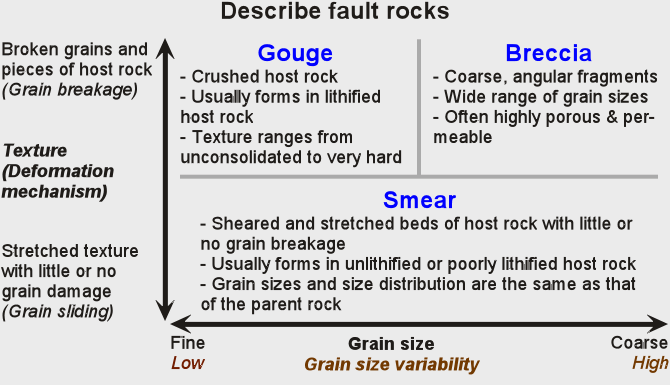
- Step 2: If your fault is a fault zone, describe the fault-rocks.
- Step 3: Record the key characteristics — orientation, evidence of faulting, slip parameters, relative age, thickness of damage zone, gross morphology, size and shape.
- Step 4: Describe the mineral fill.
Describe a compaction band
In image logs, core or outcrop record the following:
- Orientation (dip-angle/dip-azimuth)
- Evidence of relative age such as abutting and crosscutting relations.
- Overall shape, planarity or any other distinctive feature.
- Any available information on size and shape in the plane of the compaction band.
- Host lithology.
- The orientation of sedimentary layering inside and outside of the band, if the layering is visibly deflected.
Fault description - Step 4
Chart 7: Describe the mineralization
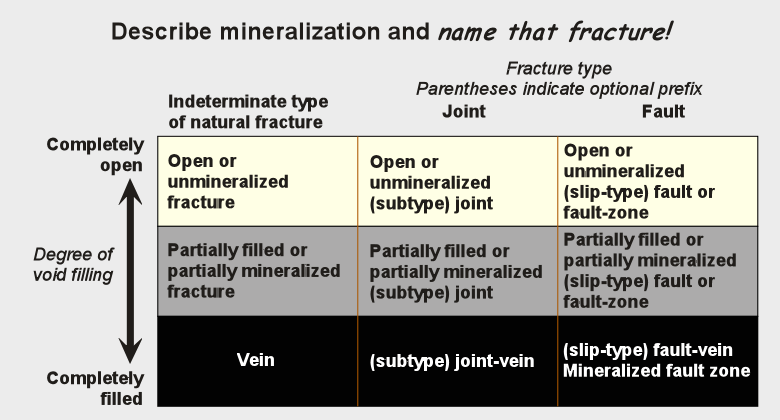
Describe the mineralization
Classify the fill type and name your fracture. Examples:
- Unmineralized reverse fault.
- Partially mineralized contained joint.
- Fracture.
- Partially filled fracture.
- Mineralized, brecciated, fault zone.
Note: deformation bands and compaction bands have very little porosity (<3%) and no large voids so that any cement or mineral fill is not readily visible and isn't described.